Trump – From Peace President to War President
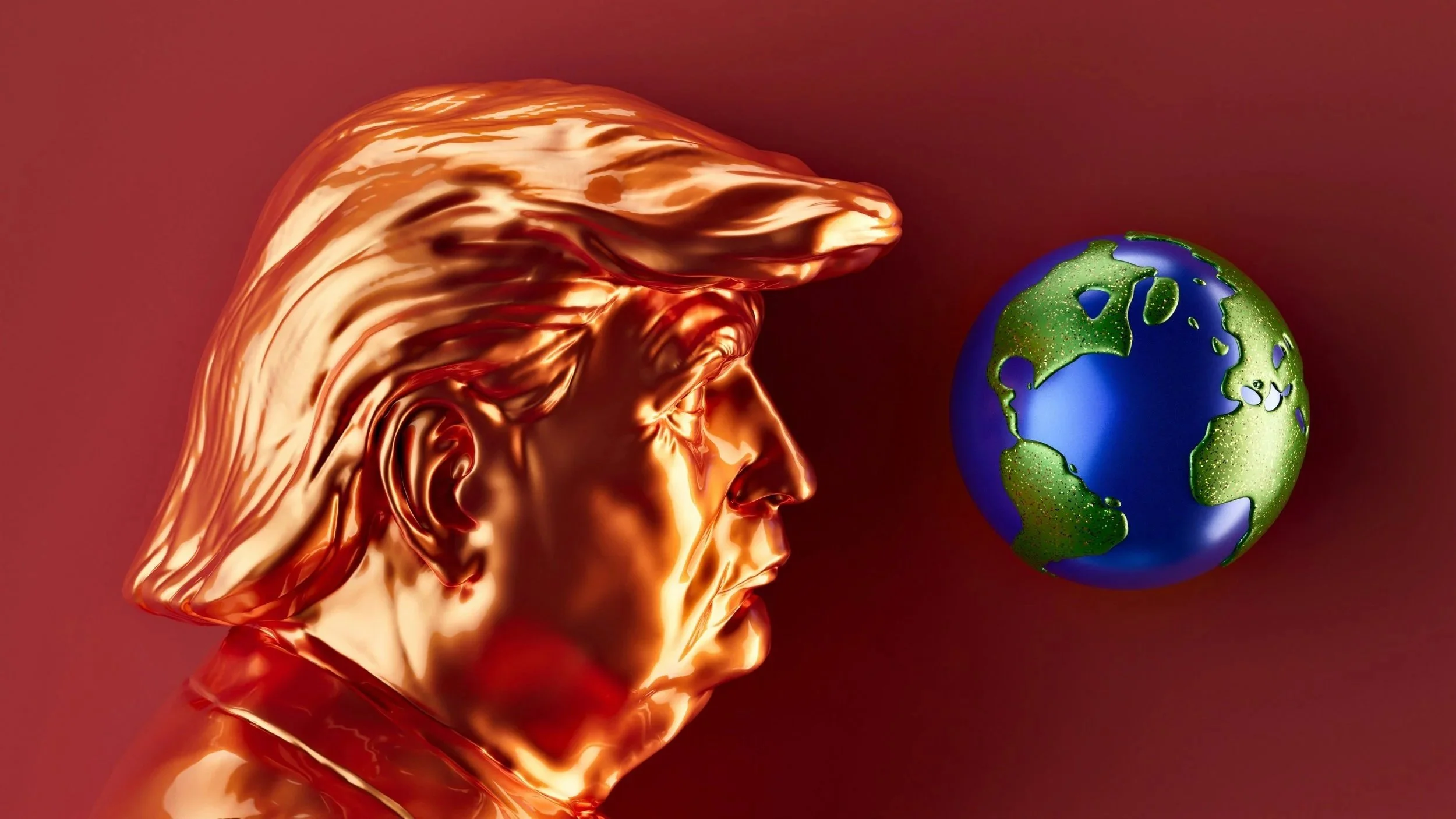
Trump began his second term with the promise that he would end wars rather than start new ones. He had already envisioned winning the Nobel Peace Prize for himself. However, things have changed dramatically. After the relatively ‘soft’ – though still illegal, military intervention in Venezuela he subsequently launched, together with Israel, a full-scale attack on Iran. As Robert Malley and Stephen Wertheim wrote (The New York Times - International Edition - March 7/8): “President Trump’s attack on Iran is astonishing in its audacity, aggression and lawlessness (...) The self-appointed president of peace has turned into an embolden warmaker.” The renaming of the Department of Defense as ‘Department of War’ already signaled the new direction of U.S. foreign policy under Donald Trump. And War Secretary Pete Hegseth further underlined this shift in mindset: “The dumb, politically correct wars of the past were the opposite of what we are doing here”.
The new determination to confront all those who are ‘violating’ President Trump’s perception of the world as it should be is, in the case of Iran, accompanied by a striking lack of a convincing strategy–or indeed any coherent strategy at all. As The Economist summarized Trump’s war in a headline: “A war without a strategy”. And in its leader, the editorial warns: “When you command a machine as lethal and overwhelming as America’s forces, united in this operation with the battle-hardened Israel Defense Forces, you have a special responsibility to define what you want to achieve”. But this is not Trump’s attitude towards the use of power. The Economist speaks of “opportunistic grabs for power whenever he sees weakness” and that is dangerous.
Again, many complain about the lack of ‘action’ by the Europeans. Yet in a world where brute force and military power count are increasingly used by the big powers, the European Union remains on the sidelines. The EU was built on cooperation and peaceful conflict resolution. Yes, the European Union must learn to gain economic and military strength. But it never will be able, and should never be willing, to go to war as easily as Putin’s Russia and Trump’s United States.
A Variety of Evaluations
Worldwide, and especially among U.S. experts and analysts, there is a wide range of evaluation of the U.S.-Israeli military attack on Iran. Professor Peter Beinart (NYT -Int. Edition - March 5th) speaks of “Imperialism masked as foreign policy”. By contrast, Bret Stephens argues that “Trump and Netanyahu did the world a big favor” (NYT - Int.Ed. March 3rd). For him “it is impossible to imagine anything like Mideast peace without the end of this regime.” Between these positions lies the view of Thomas L. Friedman, who describes the Middle East as a “complicated, kaleidoscopic region where religion, oil, tribal politics and great power politics interweave in every major story” (NYT-Int.Ed. March 4). And he adds: “In the Middle East the opposite of autocracy is not necessarily democracy. Often it is disorder”.
Thomas Friedman is correct, the situation in the Middle East is ‘complicated and kaleidoscopic’. And it can become even more complicated and kaleidoscopic due to this military intervention. There is no reason to expect the contrary at least in the near future. Anyway, can it be accepted and justified that two states just use their military power to topple the leadership of a country and announce they will kill any successor unless there is a regime change and the new leadership finds the acceptance of the foreign military aggressors?
This does not mean that one should have any sympathy for the former leadership or for successors who would imitate and continue the policies of Iran’s past cruel and aggressive rulers. But as Robert Shrimsley wrote in the Financial Times (March 6): “However much you might rejoice at the fall of the Ayatollahs, are you truly comfortable with a world whose moral compass is set by Trump and his cronies”.
No Sympathy for Either Side
There is no acceptable argument to support neither the Iranian Ayatollahs nor the one-sided and unilateral attack of the U.S. and Israel against Iran. Nevertheless, it is useful to ask if and what kind of mistakes have been made in the past by those who adhere to international law and multilateralism. The starting point must be the nuclear agreement after intensive diplomatic activities especially by the European Union, the United States, Russia and China. But it would have been useful no to stop there. Probably, the international community should have used the Nuclear Agreement signed in Vienna, the ‘JCPOA’, to develop a comprehensive policy for bringing Iran into a sustainable regional structure. The international community should have tried to put Iran under pressure concerning other critical issues, especially the aggressive policy towards its neighbors and against its own population. Perhaps a combination of such pressures with the thorough lifting of sanctions and the offer of economic cooperation would have had some chance of success.
The purpose of such a policy would have been to invite Iran to play a more constructive role in the region. Iran would not have been forced to recognize the state of Israel. But it would have been asked to stop to continuously announce the destruction of Israel. It would have had to recognize the sovereignty of all Arab states in the region and refrain from supporting various militias that destabilize democratic systems such as the one in Lebanon.
Unfortunately, for such a strategy to be successful, one would have needed the cooperation of Russia and China. But it is very doubtful that these two countries would have been supportive of such a policy. As we could see from the joint support of Russia and Iran for the devastating regime in Damascus, Russia clearly had different interests. Even most Arab countries would probably not have been willing to join such a strategy. The Arab states do not share a uniform attitude towards the Iranian regime. As developments in Lebanon have shown, Saudi Arabia, despite having significant interests there, largely withdrew its engagement and allowed Iran and its ally Hezbollah to play a major role and expand their influence. In addition, it is not clear whether such a strategy of ‘carrot and sticks’ would have worked from the Iranian side. It seems, that the Iranian leadership was, during all those years, obstinate and not open to a sincere and comprehensive dialogue. As we can see now from the decision regarding the successor of the killed leader Ali Khamenei, the clerical leadership did learn nothing from past defeats. Moreover, with the withdrawal of the U.S. under Trump 1 it became illusionary to develop and implement a constructive and forward-looking Iran/Middle East policy. And the aggressive Netanyahu policy with his right-wing extreme coalition partners was no help either.
New Policies out of the Ashes of the Iran War?
Nevertheless, the Western side – at least the European one – should have tried to develop a new and innovative strategy. A combined effort could have sent a clear signal that Europe, possibly the U.S., and at least the Arab neighbors would pursue one and the same policy. If such a united front could have been built, Russian and China would not have had it easy to follow a totally different course. And Israel would not have had it easy to convince the United States to go into war. At least not before it would be clear that such a strategy would meet no positive response from Iran.
Yes, there could have been a successful policy following the path that European countries took when founding what later became the European Union, even if one should and must take into account the many cultural and political differences between the two regions. It would have been worth to try. And again, it becomes obvious how important the new pragmatic, non-ideological and non-nationalistic policies developed in Europe after World War II were. The lack of such attitudes in the Middle East was and remains to this day the main tragedy of the Middle East. Without such an attitude the series of crises and wars will continue. And Trump’s war policies will ignite new fires and will destroy any hope that his ‘Board of Peace' will be successful.
One must add that the U.S. is once again trying to use the Kurds to implement its strategy – as they already did in Syria. President Trump is asking them to start an uprising against the Iranian leadership. But that may trigger a reaction from other ethnic groups in Iran. They may either join the Kurds, because they aspire a dissolution of the country or they may start to fight against the Kurds as they want to keep the unity of the country and object to any division along ethnic lines. In the end the U.S. may again betray the Kurds and let them fight alone without U.S. support.
If one is very optimistic, one could imagine that after the war a new opportunity would arise to develop a regional structure of economic and political cooperation. If not in imitating the example of the European Union, maybe in learning from the OSCE – in better times. Again, this endeavor would need another United States policy with a president who is less interested in personal enrichment and power but in contributing to sustainable world peace. And it would at least require that Russia and China refrain from destructive interference. In this case, the European Union could play a constructive role and help to establish a Middle East that may not be free of conflicts but would at least be free of wars.

Dr. Hannes Swoboda, President of the International Institute for Peace (IIP), started his career in urban politics in Vienna and was elected member of the European Parliament in 1996. He was Vice President of the Social Democrat Group until 2012 and then President until 2014. He was particularly engaged in foreign, enlargement, and neighborhood policies. Swoboda is also President of the Vienna Institute for International Economics, the Centre of Architecture, the University for Applied Science - Campus Vienna, and the Sir Peter Ustinov Institute.