IIP Vice President Angela Kane’s commentary in “What the End of New START Means for Europe: Two Views” (Bulletin of the Atomic Scientists, with Héloïse Fayet contributing the second article)
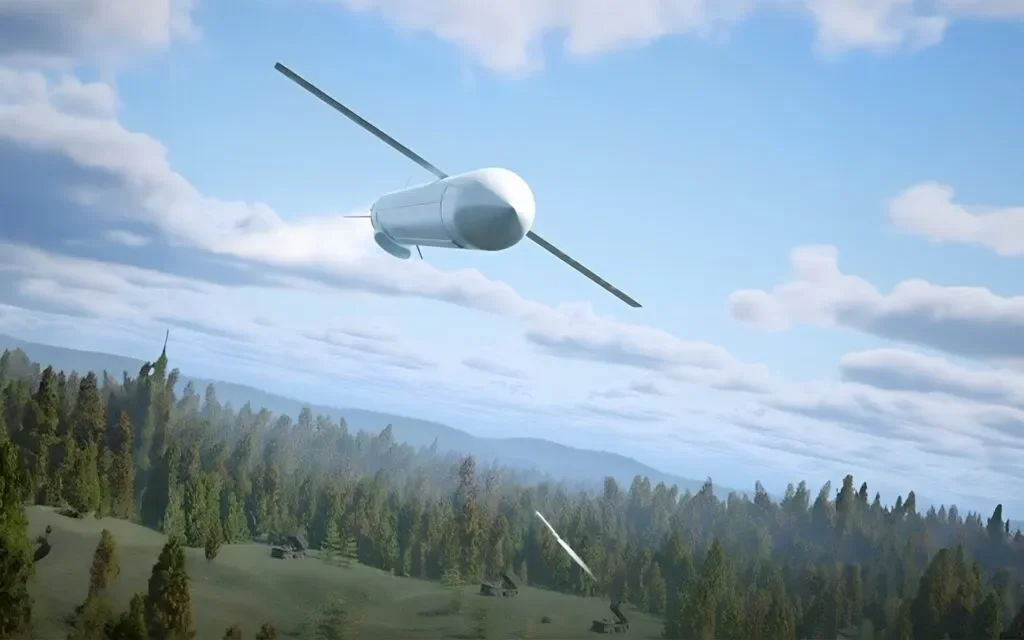
Image credit: MBDA
An artist's illustration of the Land Cruise Missile (LCM) system being developed by France for deep precision strike capability. Europe seeks to address the risks posed by Russia's large and unconstrained arsenal of non-strategic nuclear weapons, which were never covered by New START.
The erosion of the rules-based global order has been a constant topic of discussion in the last few years. One of the most serious illustrations of that trend is the end of half a century of bilateral arms control agreements between the United States and the Soviet Union, then Russia, with the expiry earlier this month of New START—the last in the long line of negotiated bilateral agreements to bring down nuclear arsenals.
These agreements were able to constrain the number of US and Russian deployed warheads and delivery systems. But numbers are only one face of the arms control coin. Equally important were the extensive requirements for data exchanges and verification, including on-site visits that were embedded in the treaties.
New START’s expiration was not a surprise, though. It had been renewed for five more years in 2021 and could not be extended further past this February. Moreover, the offer by Russian President Vladimir Putin in September to continue observing the limits imposed by the treaty for a year was not taken up by US President Donald Trump. At the time, Trump said it was “a good idea,” but he also told reporters last month that, “If it expires, it expires. We’ll do a better agreement.” It has now expired. And there is no better agreement in sight.
Arms control negotiations are protracted, complex, and highly technical, and they often extend for years before an agreement is reached. There is little possibility of concluding a fast and transactional deal, like the ones the current US administration seems to favor. Still, the lack of any arms control talks—let alone ongoing negotiations—has profound implications for global nuclear posture. Without restraints, one can expect more nuclear weapons, more modernization plans, and a renewed nuclear arms race fueled by geopolitical instability.
Civil society has vigorously demanded action to address arms control issues, and many experts urged the US administration to take up President Putin’s offer. Yet reactions to the expiration of New START remained few and largely muted in Europe, despite being a major beneficiary of the caps on numbers, deployment, transparency, and predictability of these bilateral arms treaties. Instead of official statements, there were short remarks couched in general language, often stressing restraint in the face of strategic instability or echoing President Trump’s demand that China join arms control negotiations.
Why the reticence?
The loss of New START has strong security implications for Europe, and while earlier US administrations were protective in shielding Europe from the risk of military aggression, this has changed under President Trump. Rather than being a reliable protector, he has repeatedly shown himself to be dismissive of Europe and NATO, sidelining the Europeans in the negotiations with Ukraine and being needlessly offensive, as when the US National Security Strategy released in December claimed Europe was facing “civilizational erasure.”
But Europe is not without agency. It should move to shape US policies that have vital consequences for the continent. Europe has already moved to stronger deterrence and military cohesion, supported by increased defense expenditures, but this must be followed by proposals and demands for concrete arms control measures, replacing not only New START but also previous nuclear treaties which had been abrogated in earlier years. Without caps on deployment and the associated benefits—like notification, inspection, verification, and treaty compliance mechanisms—of an agreement between the United States and Russia, Europe is left exposed to the possibility of sudden attacks and aggression.
In this situation, the collaboration on nuclear issues must also extend to the Nuclear Non-Proliferation Treaty (NPT), whose Review Conference will take place in the spring of this year. The demise of New START will undoubtedly be heavily criticized by the non-nuclear-weapon states parties. They see this as a failure to implement Article VI of the NPT, in which states commit to “pursue negotiations in good faith on effective measures relating to cessation of the nuclear arms race at an early date.”
But rather than wait for the review conference to take place, Europe—through France and the United Kingdom, which are among the five permanent members (P5) of the UN Security Council—should intervene in the P5 process in which principals meet, to exchange views on nuclear doctrines and postures and to coordinate policies. While the process was disrupted in 2022 after Russia invaded Ukraine, it continues, albeit at a lower political level. The United Kingdom, which chairs the P5 process this year, is well-placed to advance Europe’s arms control agenda.
While deliberations are not public, it might be most helpful to draw up a list of talking points to urge the parties to address the lack of nuclear arms control treaties without putting forward demands that are known beforehand to be unacceptable, such as insistence that China sit at the negotiating table. With willingness will come trust and cooperation. But it takes time and unrelenting effort.
Arms control discussions should build upon Putin’s offer to continue observing New START’s limits and Trump’s call for negotiations on a “new, improved, and modernized” nuclear arms control agreement.
Of course, negotiating a new treaty in the current geopolitical environment will be extraordinarily difficult. It will require years of work by technical experts, trust among participants, and diplomatic skill—none of which currently exists at the necessary levels. Yet arms control should not fall victim to geopolitical tensions and ruptures: It is not a “nice-to-have”; it makes the world safer and ensures its very survival. There is no need to relive the experience of a world without such guardrails.

Dr.h.c. Angela Kane became Vice President of the IIP in 2016, after serving on its International Advisory Board. She is Visiting Professor and Strategic Committee member at SciencesPo’s Paris School of International Affairs, Visiting Professor at Tsinghua University Schwarzman Scholars in Beijing, Chair of the United Nations University Council, and Senior Fellow at the Vienna Center for Disarmament and Non-Proliferation. Kane held numerous UN roles, including High Representative for Disarmament Affairs (until 2015), Under-Secretary-General for Management (2008–2012), and positions in the Department of Political Affairs as Assistant Secretary-General and Director. She supported special political missions in Iraq, Nepal, and the Middle East, helped establish the International Commission against Impunity in Guatemala, and gained field experience as Deputy Special Representative in UNMEE, on assignment in the DRC, and in multi-year postings in Indonesia and Thailand.