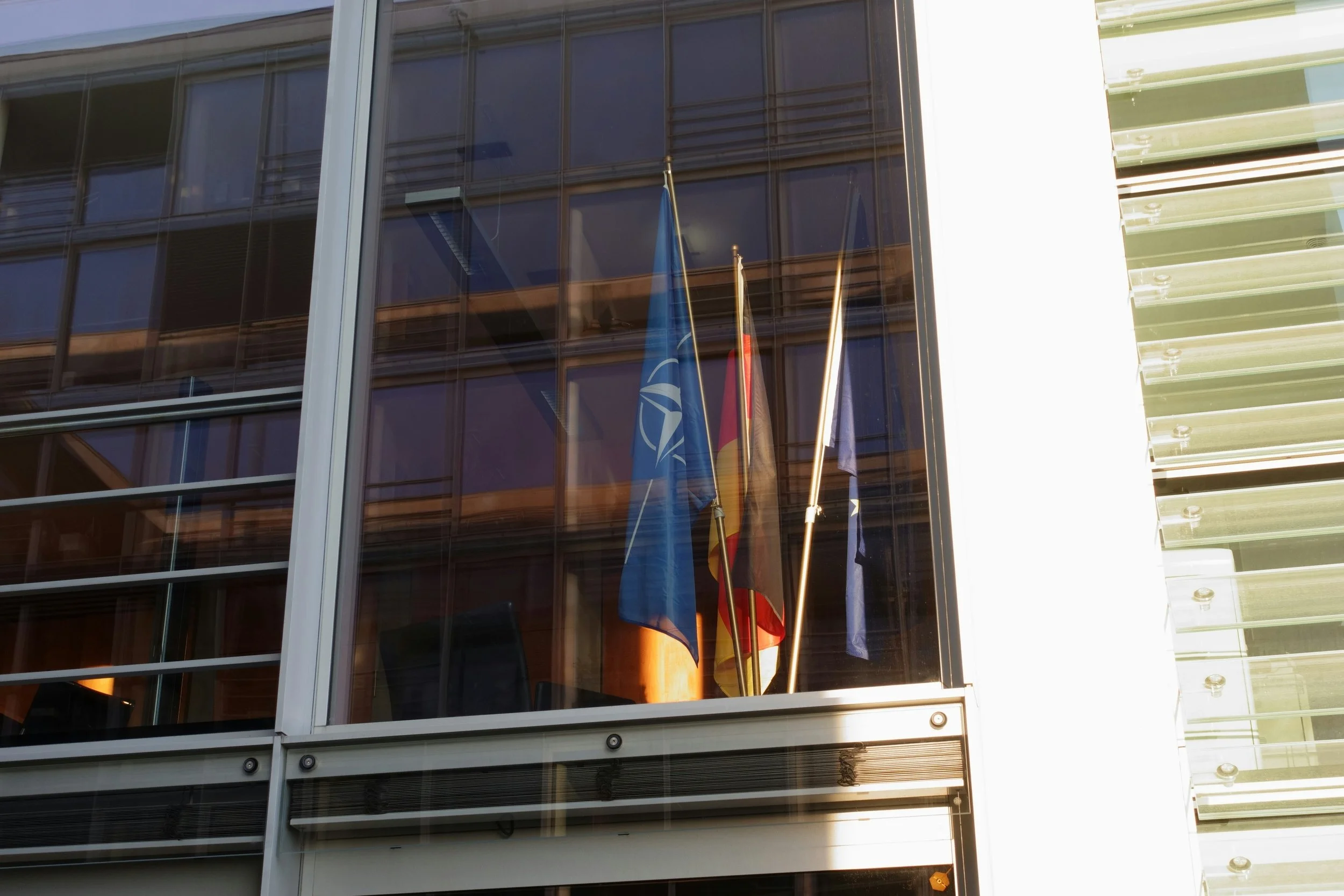
The efforts for an effective European defense has a long and contradictory history. The original plan to establish a European Defense Community on the basis of a German-French alliance failed 1954 due to a negative vote in the French Parliament. Due to this failure European defense was „only“ organized in the framework of NATO, that means in the framework of the transatlantic community. But things changed dramatically.
Under the headline „It’s the end of NATO as we know it“ Rajan Menon, Professor emeritus at the City College of New York, wrote in the New York Times - International Edition (January 26th, 2026): „For European leaders, infantilized by decades of reliance on American protection, a world without NATO is all unimaginable. But they must open their minds. Only by jettisoning their supine attitude and committing to military autonomy can Europe, along with Britain and Canada, free itself from dependence on a country that more and more, views its traditional allies with scorn and condescension.“
From rules based order to gunboat capitalism
There is no doubt that we experience at the moment an enormous disruption in international relations. What was a - mostly US led and often violated - rules based order is more and more transformed into a system which is characterized by use of brutal power. A recent edition of The Economist (January 17th-23rd, 2026) had on its cover the title: „The Return of the Gunboat Capitalism“. It is not gunboat diplomacy which Donald Trump is implementing, because he is definitely not a friend of diplomacy. He is instead using threats and force to attain primarily economic - including territorial - gain. Certainly, Trump is not the first one to follow such a strategy. Also, European countries have been very actively engaged in grabbing foreign territory. But European countries have - by uniting on a voluntary basis after World War II - started to learn from its dreadful history. Others did not, they want to go back in history repeating the failures and crimes of the past. In this connection it is interesting, that Trump and Putin have imperial predecessors as their heroes and pictures of these heroes on the wall in their offices.
Simon Kuper in the Financial Times (24/25 January, 2026) speaks about „The return of landgrab”: “Trump embodies the new geopolitical trend: international relations is increasingly about real estate.” There are many cases of “expansion through land grabs”: Russia does it in Europe, Israel does it in the West Bank and likes to do it - together with the US - in Gaza, the US tries to get Greenland, and China does it in the South China Sea and is ready to grab Taiwan. Land grabbing has become an acceptable form and instrument to acquire foreign land and/or resources. And so, the big powers of our globe became aligned in following such policies, irrespective of their ideological, political and economic differences. As long as each of them finds some land in its neighborhood to grab, they can tolerate the actions of the others. But of course, it can become critical when they compete about the same territory - like in the Arctic regions.
As mentioned, some of the conflicts of the Unite States with Europe concern also territory. On the one side Europe is confronted with Trump’s direct grab for Greenland - which lead recently to a hardly resolved conflict. On the other side it’s the tolerance and readiness of Trump to grant Russia access to some territory of Ukraine - and for the rest he wants at least to have control of critical Ukrainian resources. In both cases this US attitude contradicts European principles of respect for territorial integrity. It was one of the main achievements of the new Europe, that borders should not be questioned and changed by unilateral force.
Ideological fights and cognitive warfare
But the conflict of the present US-administration with Europe is a much more principal one. Specifically, Europe is confronted with a deep ideological challenge, not only between the US-administration and Europe‘s - still majoritarian accepted - values. Trump, supported by the religious right wing with JD Vance but also by his libertarian followers in Big Tech practices a deliberate influence on nationalist groups in Europe. In view of this right-wing transatlantic alliance, those Europeans, who want to defend the principles and values of the post war Europe, must fight against Trump‘s ideology also in Europe itself.
Bruno Macaes, political scientist and former Portuguese politician wrote recently on „substack“ (January 19th), that he noticed since some years already an increasing „Europhobia“ „developing among a new generation of American elites, the kind of Europhobia today represented by the National Security Strategy, issued by the Trump administration in December in which Europe is portrayed as a civilizational enemy.“ It is obvious, that this attitude towards Europe expressed last year by JD Vance at the Munich Security Conference and this year by Donald Trump himself at Davos is a guideline for this administration’s foreign policy. But how can Europeans win that ideological dispute?
Europe with its weakness and strength
In their recent Foreign Affairs article „How Europe Lost“ (January/February 2026) Matthias Matthijs and Natali Tocci criticized that the Europeans „have reflexively and consistently adopted a posture of submission“ towards Trump and that „they still have not developed a robust and coherent European strategy for their long-term defense that does not in essence rely on the United States.“ But then they confess, that the EU can only „take smaller steps on defense and trade that would reduce its dependence on the United States.“
Anyway, reducing the links with the US does mean to strengthen ties with other powers. Very often it is argued that Europe should find new alliances with China. And a recent opinion poll organized by the European Council for Foreign Relations ECFR shows a rising evaluation of China - also by Europeans - as a necessary partner and the willingness of Europeans to strengthen the relations with China. But as Gideon Rachman wrote in the Financial Times (24/25th January, 2026): „Paradoxically, de-risking from America means accepting more China risk“. Yes, it will be necessary to extend commercial and political relations around the globe - including with China. But China is not an innocent partner either, only interesting in economic ties. Europe must be very careful not to create new political, ideological and economic dependencies - this time on China. De-risking must be a general attitude in the interest of European security.
Coming back to the US-EU relations and the European reaction to Trump’s trade proposals another aspect is important and also mentioned by Matthijs and Tocci, when they refer to the „cacophonous chorus, with key member states preemptively voicing their opposition to retaliation.“ But this cacophony is not only due to different national interests. It is more and more influenced by the nationalistic - mostly right wing - forces in Europe itself. It is just that nationalism which Europeans who built the new Europe wanted to leave behind. As the French President Francois Mitterand - already characterized by age and illness - exclaimed in his last speech in the European Parliament: „nationalism - c‘est la guerre” - nationalism leads to war. And he added that war in Europe may not be something of the past, but perhaps something of the future - and right he was, unfortunately. But some political forces decline to learn from European history.
Europe as a separate civilization
To overcome the ugly past and prevent new wars between European nations the European Union was founded. And it is based on a specific civilizational attitude. An attitude which is challenged not only by Russia and China but recently also by a Unites States governed in an authoritarian way by Donald Trump. According to Bruno Macaes, Europe must understand itself as a „civilization state“: „This type of state differs from both national and liberal states in that it rests on values rather than nations, but these values are not seen as universal…..It is in this effort to preserve itself against American power that Europe can, at long last, become Europe.“
If one follows these arguments, nationalism has to be overcome or perhaps better be enclosed and enfolded into an European - value oriented - patriotism. But what kind of values must be protected and defended? There is definitely not a common sense about values. One of the reasons why the answers and reactions to Trumps demands are so weak is the polarization inside the European countries and the European institutions like the European Parliament.
Many economists, like Matthew Burgess argue, that the decrease and lack of economic growth - which became a characteristic of European economies - is one of the main factors why people are disappointed by democratic states and governments. And why they look with pessimism into the future of their country and Europe as a whole. The lack of growth increases the competition about scarce resources - especially between old and young and between different ethnic groups like native citizens and immigrants. And this leads also to a stronger polarization in European societies. But as there is not much hope for a drastic change in economic growth and/or redistribution towards lower income groups via higher taxes of the rich, European leaders must take special efforts to fight against public pessimism and strong polarization.
This increased polarization found in many European societies has to be weakened by an intensive dialogue with the citizens. European leaders have to work on building confidence, that Europe has values which are worth to defend. And finally, that Europe is also able and ready to defend these values. But what are the principles and values Europeans should be proud of? Europeans should also be proud of these values, because they had to fight, that they are respected by the state and its authorities. Even as they are still again and again violated. But Europeans learned to correct wrong developments, because they are able to develop doubt, skepticism and self-criticism as part of their value system. Some of these values characterizing the European civilization and which are the basis of European identity are the following:
Conflict resolution by negotiations instead of war.
Respect of rule of law and independence of judiciary.
Clear limits for police actions and the domestic use of military.
Freedom to express one’s opinion as far as it is not violating and hurting other people.
Respecting democratic principles and rights, including for free and fair elections.
The right to organize as trade unions, businesses associations etc.
Respect for all people irrespective of their origin, race, sex, gender and religion.
Laws preventing arbitrary state actions.
Concern and care for poorer members of society, including an adequate and affordable provision of housing and health services - a functioning social system.
Freedom of and for research and science.
Mobilization of Europe’s citizens
If one seriously compares Europe with countries like Russia, China but in the meantime also with the United States, one can see that Europe has developed another kind of civilization in comparison to these nations. Not that the US, Russia and China have the same civilization and the same kind of authoritarian rule. Not that the European Union is perfect and always sticking to its values and principles - and that is true also for its member states. Far from it, but there are decisive differences between the values and principles which Europe developed after centuries of colonialism and wars. And especially as Sylvia Kauffman of Le Monde was stating in her comment in the Financial Times (27.1.2026) : “Modern European identity was built on the ruins of a continent devastated by war and totalitarianism.” These values and principles can be defended with firm conviction against those who attack these principles as weak, soft and outdated.
But nevertheless, these principles and values are not self-evident to everybody. They must be argued and defended also inside Europe itself. The major contribution for a strong answer and reaction to Trump’s (or Putin’s) challenge is not the use of strong words and threats. It is a job which has to be done predominantly domestically.
Europe has many tasks to fulfill in order to gain strength. European leaders need to design and implement a stronger science, research and technology strategy. It needs an efficient common European capital market to offer financial opportunities to our businesses instead of financing the US-businesses and -state. Europe has to overcome national prerogatives, pride and interests in enhancing European military capacities and capabilities. These economic, technological and military challenges should not be underestimated.
But - one should and must not forget - Europe must primarily win the majority of its citizens in order to be able to defend the very values and principles on which a successful European Union was build. And even if threats perceptions are different, values and principles should be similar. Nevertheless, public authorities in the different member states have to look into the specific values and principles its people want to safe and defend with priority. And out of different national risk-perceptions, national narratives and priorities a common defense strategy has to be developed.
As the rather conservative Belgian Prime Minister Bart De Wever said it bluntly after he mentioned that many red lines have been crossed by Trump: “Being a happy vassal is one thing. Being a miserable slave is another.” So, Europe should not go the way from happy vassal to miserable slave but from happy vassal to confident partner - able to act alone if necessary. And the European patriotism based on pride and confidence could also be the basis for a new relationship with a United States. A United States which would be less arrogant and with a less erratic and imperial leadership could still be a military ally. And a confident Europe could also be one which is offering a Russia, which refrains from aggression and land grab, a new constructive relationship to maintain peace in Europe.

Dr. Hannes Swoboda, President of the International Institute for Peace (IP), started his career in urban politics in Vienna and was elected member of the European Parliament in 1996. He was Vice President of the Social Democrat Group until 2012 und then President until 2014. He was particularly engaged in foreign, enlargement, and neighborhood policies. Swoboda is also President of the Vienna Institute for International Economics, the Centre of Architecture, the University for Applied Science - Campus Vienna, and the Sir Peter Ustinov Institute.