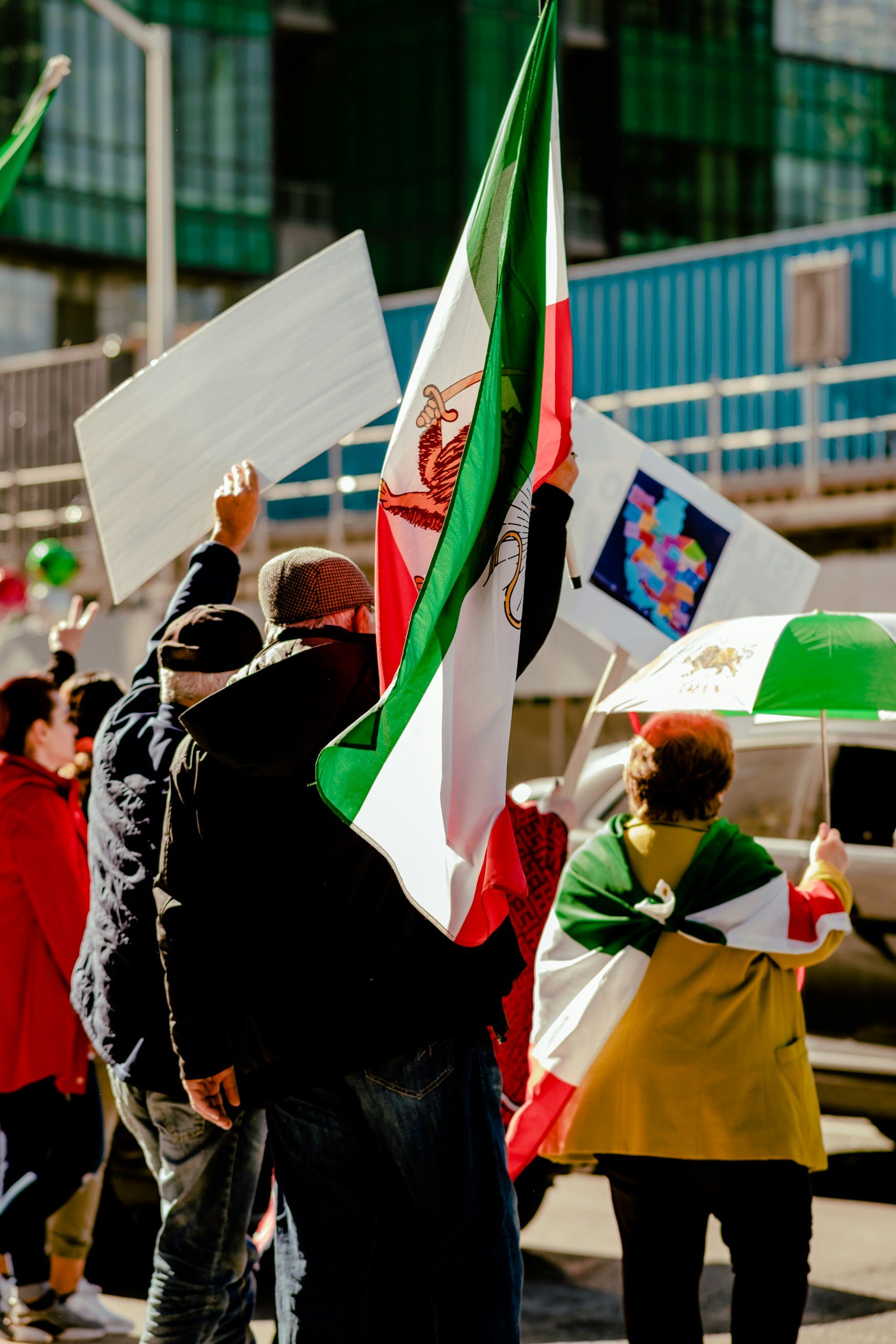
With horror, sadness and helplessness we look at the reports from Iran. Again the regime is crushing the massive protests and killing thousands of innocent people. Could we in Europe have done better, should we have developed another policy to prevent the regime developing into a rogue - and at least regionally - dangerous regime?
Iran’s destructive policies
The public authorities of Iran developed three critical policies which more and more raised fears and concerns in the West, especially in Europe. Instead of bringing democracy and freedom after the fall of the authoritarian Shah regime, violations of democratic principles and human rights increased soon after Ruhollah Khomeini came into power as Supreme Leader. These policies were confirmed by his successor Ali Khamenei. Secondly, in contradiction to the rejection - in the form of a fatwa - of the nuclear bomb by Khomeini himself, Iran tried to develop its nuclear capacity close to the possibility to build the bomb. Iraq’s aggression against Iran was certainly an additional motivation for Iran’s nuclear policy and its general militarization. The third critical policy was the spreading of revolutionary forces in the neighboring countries and the questioning of Israel’s very existence.
The West, and especially the European Union, concentrated its Iran policies on the nuclear issues. The Europeans were the strongest promoters of the so-called JCPOA agreement, which was concluded in Vienna. Heinz Gärtner, chair of the advisory board at the IIP, is the internationally leading expert on the JCPOA and there is nothing to add to his analyses (which can be read here). But after Donald Trump cancelled the agreement - to the delight of Benjamin Netanyahu - Iran felt no necessity to stick to the principles of the agreement and sanctions were bringing hardship to ordinary citizens again - not to the regime and its main supporters, the Revolutionary Guards.
Concerning the spread of “revolutionary” violence in the neighborhood, Iran had to realize recently some heavy setbacks. The brutal Assad regime supported jointly - even if not always in full agreement - by Iran and Russia broke down. Hezbollah was decisively weakened by Israel’s attack and the bombing of nuclear facilities by the U.S. and Israel was another blow to the regime. Additionally the deterioration of the environmental conditions and especially concerning the water supply in Teheran and other cities challenged the regime. But it did not want to change its policies.
Has Europe realized an appeasement policy?
The question I want to raise in this short commentary is, if the European Union and its member countries could have moved the Iranian authorities to a more constructive citizen-oriented policy. From my personal experience, it would have been very difficult in view of the stubborn attitude, filled with mistrust from the side of the Iranians. Europe was and is historically closely connected to Israel. And many Israeli governments and especially Netanyahu saw Iran as the main enemy. Israel wanted to remain the only nuclear power in the Middle East and Iran was the main challenger to that monopoly. The aggressive policy of Iran in Israel’s neighborhood was an additional challenge for Israel. The main European goal was to prevent Iran from becoming a serious nuclear threat to Israel and other countries in the region.
With all that regional and geo-political issues and concerns the criticism of domestic policies - lack of respect for human rights and neglect of citizens' interest to have decent living conditions - were pushed into the background. Nevertheless, it is doubtful if stronger activities of European countries in this respect would have had a decisive influence on the Iranian leadership. Whenever I met officials from Iran as a Member of the European Parliament - in Brussels or in Tehran - I raised the issue of human rights and especially of women's rights, as did my colleagues. But we were all confronted with the argument that we see things from a Western European perspective and do not recognize and accept the specific cultural characteristics of Iran and the Shia religion. The death penalty was also presented to us as such a specific, indispensable element of Iranian culture and Islam. Nevertheless we should have raised these issues even more and more often - in spite of the Iranian paranoia that we all wanted to harm the Iranian people and undermine the Iranian sovereignty.
Sara Bazoobandi, a fellow at the Italian Institute for International Political Studies - ISPI asks in a comment of the recent ISPI Newsletter: “Is Europe’s era of appeasement towards Iran coming to an end?” And she argues: “The war in Ukraine has fundamentally altered perceptions of Iran, transforming it from a distant regional concern into an immediate security threat. Iran’s provision of military drones and other weaponry to Russia has directly implicated Tehran in a conflict on European soil.” On the other hand, Russia is supplying Iran with special weapons and sophisticated internet suppression technologies to fight against the demonstrators. The text of the “Comprehensive Strategic Partnership” concluded in 2025 is in this context revealing. (See: Nicole Grajewski, “How Russia Is Supporting Iran’s Repression” in Foreign Policy January, 14, 2026)
Different strategies approaching Iran
Now different actions in support of the Iranian protesters are discussed, including a military intervention by the U.S. Some, like Vali Nasr from Johns Hopkins University argue, that “economic pressure could hurt more than a military strike” (Financial Times, 14.1.2026). But economic pressure only by the West would not be very successful. It would push Iran even further into the authoritarian camp of Russia and China. Some argue that Trump should „encourage countries that still have diplomatic relations with Tehran to expel Iran diplomats“ (Suzanne Maloney of Brookings Institution in International New York Times 14.1.2026). This again would only be respected by the Europeans and would strengthen the ties of Iran with the other „rogue“ states.
And what about military intervention? Suzanne Maloney wrote in her article: “The American military can deploy world-class coercive and deterrent capabilities, but its track record in advancing stable, democratic transitions is notably less impressive, especially in the Middle East.” One has also to see that there still is a strong alliance between the Supreme Leader Ali Chamenei and the Islamic Revolutionary Guards Corps with its strong economic resources and interests. As long as this alliance holds there is nearly no chance of fundamental change.
Additionally - as Karim Sadjadpour mentioned in a recent podcast with the magazine “Foreign Affairs” - four of five recent transformations of authoritarian regimes ended in new authoritarian structures. The “best” examples are Tunisia and Egypt. It is not yet clear what kind of transformation we will see in Syria. In his “Foreign Affairs” article of November/December 2025 “The Autumn of the Ayatollahs” Karim Sadjadpour sees the future of Iran bleak. After the presen turmoil, Iran could end up as another Russia, China, North Korea, as another Pakistan or at best, as another Turkey “with elections that bring a popular leader to power, initial reforms that resonate a gradual slide into majoritarian authoritarianism cloaked in the language of democracy.”
Iran as “another Turkey” would certainly be preferable to the present brutal regime. But whatever the likelihood of the transformation of a brutal regime into a more responsive, even authoritarian system, the Europeans should carefully support such a transformation. And it would be good to have partners in the region who would be on the same line.

Dr. Hannes Swoboda, President of the International Institute for Peace (IIP), started his career in urban politics in Vienna and was elected member of the European Parliament in 1996. He was Vice President of the Social Democrat Group until 2012 and then President until 2014. He was particularly engaged in foreign, enlargement, and neighborhood policies. Swoboda is also President of the Vienna Institute for International Economics, the Centre of Architecture, the University for Applied Science - Campus Vienna, and the Sir Peter Ustinov Institute.